Schedule C, Part II

Every expense line on Schedule C, and what belongs on it

There are 24 numbered expense lines, and the hard part isn't finding them. It's that your actual spending doesn't announce which one it belongs to. There's no line called software, none called bank fees, and the one place most people look for their home office isn't in Part II at all. Here's the full deductions list as the IRS prints it, then where the everyday things go.

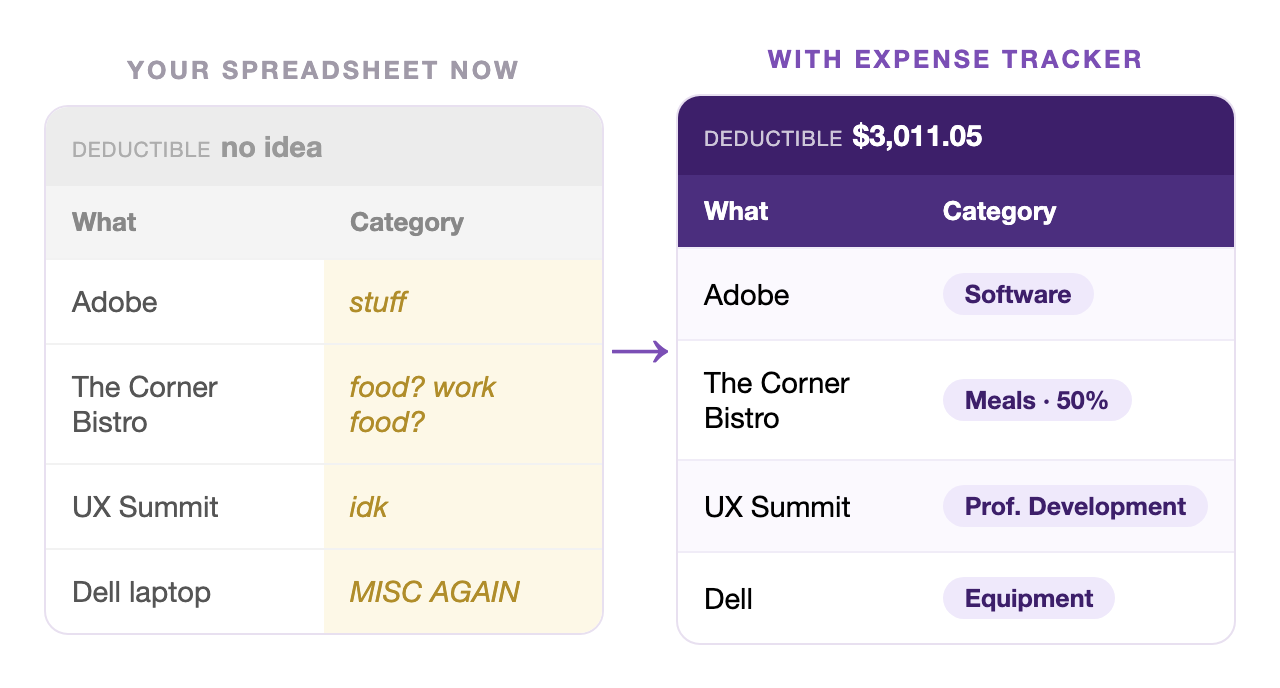
A messy pile of receipts beside the same expenses logged and categorized in a spreadsheet
Expense Tracker for Sheets™: every expense logged against the line it belongs to.

Free · from Marinette

Expense Tracker for Sheets™

Install free from the Marketplace →

No account to create · No website login · Your data stays in your Google account

Worth saying plainly: this is a plain-English map of the form's own lines, not tax advice. The IRS instructions for Schedule C are the authority, and if your situation has any complexity in it, an accountant costs less than getting this wrong.

The 24 expense lines

LineAs the form saysWhat tends to land here
8AdvertisingAds, printing, business cards, a logo, your website
9Car and truck expensesStandard mileage or actual costs, one or the other
10Commissions and feesReferral cuts, sales commissions, agent fees
11Contract laborFreelancers and subcontractors. 1099-NEC if over $600
12DepletionNatural resources. Rare outside extraction work
13Depreciation and section 179 expense deductionLaptops, cameras, equipment that lasts beyond a year
14Employee benefit programs (other than on line 19)Benefits for employees, not for you as the owner
15Insurance (other than health)Liability, professional indemnity, business property
16aInterest: Mortgage (paid to banks, etc.)Mortgage interest on business property
16bInterest: OtherBusiness loan and business credit card interest
17Legal and professional servicesAccountant, attorney, bookkeeper
18Office expenseSoftware and subscriptions usually sit here, plus postage
19Pension and profit-sharing plansPlans for your employees. Your own goes on Schedule 1
20aRent or lease: Vehicles, machinery, and equipmentLeased equipment, rented gear
20bRent or lease: Other business propertyOffice or studio rent, coworking. Not a home office
21Repairs and maintenanceFixing equipment or business premises
22Supplies (not included in Part III)Consumables used up in the work itself
23Taxes and licensesBusiness licenses, permits, payroll taxes, sales tax paid
24aTravelFlights, hotels, ground transport. What you actually paid
24bDeductible mealsBusiness meals, limited. Note who and why
25UtilitiesPower and internet for a dedicated business space
26Wages (less employment credits)Payroll for employees. Not owner draws
27aEnergy efficient commercial bldgs deductionAttaches Form 7205. Not a catch-all, despite older guides
27bOther expenses (from line 48)The real catch-all. Itemize them in Part V

Line numbers and labels are quoted from the IRS Schedule C (Form 1040), read July 24, 2026. The right-hand column is plain-English guidance, not the form's wording. Check the instructions before you file.

Five places people put things on the wrong line

The home office isn't in Part II. The heading of Part II says it outright: enter expenses for business use of your home only on line 30. Line 30 then says not to report those expenses anywhere else. So the rent and the electricity for the room you work in don't go on 20b and 25 as well. It's one place or the other, and for a home office it's line 30.

Line 27a stopped being the catch-all. Plenty of articles still say other expenses go on 27a. On the current form 27a is the energy efficient commercial buildings deduction, which attaches Form 7205. The catch-all is 27b, and its total comes from line 48 down in Part V, where you write out what those other expenses actually were.

Mileage or actual costs, never both. Both roads end at line 9. Either you take the standard mileage rate for your business miles, or you add up what the vehicle really cost to run and claim the business share. Picking one per vehicle per year is the rule people most often trip over, usually by taking mileage and then adding gas receipts on top.

Your own health insurance and retirement aren't business expenses. They're still deductions, just on Schedule 1 of your 1040 rather than in Part II. Line 15 is insurance other than health, and line 19 is for plans covering employees. Deducting your own premiums on Schedule C is a common and expensive mistake, because it also changes the profit your self-employment tax is calculated on.

There's no software line, and that's fine. People hunt for one, then invent a spot. Most business software and subscriptions sit on line 18 with office expense. Anything genuinely without a home goes to 27b through Part V, described in your own words. A well-named other expense is better than a wrong line.

Where everyday spending goes

This is the mapping Expense Tracker for Sheets™ uses. Each category it offers is tied to the Schedule C line it belongs to, so the year's total arrives already sorted by line rather than as a pile you sort in April.
What you spent it onWhere it goes
Stripe, PayPal, Square feesPart V, carried to line 27b
Etsy or eBay transaction feesLine 10, commissions and fees
Interest on a business loan or cardLine 16b, not a personal card
Software and subscriptionsLine 18, office expense
Phone and internetLine 25, business-use share only
A course, a book, a conferencePart V, carried to line 27b
Laptop or cameraLine 13, depreciation or section 179
Coworking deskLine 20b
Room in your houseLine 30, on its own
Miles driven to a clientLine 9, mileage or actual, not both
Lunch with a clientLine 24b, limited, note who and why
Your own health insuranceSchedule 1, not Schedule C
SEP-IRA or Solo 401(k) for yourselfSchedule 1, not Schedule C

None of this is hard once a year. It's hard 300 times a year, in a parking lot, on a phone, three weeks after the thing was bought. That's the actual problem with expense categories, and it's why the answer is logging them as they happen rather than reconstructing them from a bank statement in April.

Where mileage goes on Schedule C

Line 9, Car and truck expenses. With the standard mileage rate you multiply your business miles by the IRS rate for the year, and that dollar figure goes on line 9. You also answer the vehicle questions in Part IV, which asks when the car went into service and how the year's miles split between business, commuting, and everything else. If you deduct actual costs instead, meaning gas, repairs, insurance and depreciation, the business-use share of those goes on the same line 9. Parking and tolls ride along on line 9 either way. They aren't part of the mileage rate, so you can claim them on top of it.

What belongs on line 10, Commissions and fees

Commissions you paid so a sale could happen: sales commissions, referral and finder's fees, and the selling fees a marketplace or platform charges you. Two things that look similar belong somewhere else. Payments to contractors for their work go on line 11, Contract labor. Routine bank and card-processing charges usually land in Part V and carry up to line 27b, Other expenses.

What “Misc Exp (Other)” means on Schedule C

Schedule C itself has no line with that name. It's bookkeeping-software language, and it maps to line 27b, Other expenses. Line 27b isn't a junk drawer, though: it's the total of a named list you write out in Part V, one entry per expense type, like software, bank fees, or education. Anything that genuinely fits a numbered line should go on that line instead, and Part V is only for what's left over.

Sorted by line, all year, not in April.

Expense Tracker for Sheets™ is free. No card, no account to create.

Install Expense Tracker for Sheets™ free →

Common questions

There's no software line. Most people put business software and subscriptions on line 18, office expense, and that's the usual home for it. Anything with no natural line goes to other expenses, which you itemize in Part V and carry to line 27b.

Line 30, not Part II. The form says so in the Part II heading itself: enter expenses for business use of your home only on line 30. Line 30 also says not to report those expenses elsewhere, so a home office's rent and utilities don't belong on 20b or 25 as well.

No, it's one or the other for a given vehicle in a given year, and both land on line 9. Either take the IRS standard mileage rate for your business miles, or total what the vehicle actually cost to run and take the business-use share.

Not any more, though plenty of older guides still say so. On the current form, 27a is the energy efficient commercial buildings deduction and attaches Form 7205. Other expenses is 27b, and its total comes from line 48 in Part V.

Usually not on Schedule C at all. Self-employed health insurance premiums and your own SEP-IRA or Solo 401(k) contributions are deductions on Schedule 1 of Form 1040. Line 15 covers insurance other than health, and line 19 covers plans for your employees.

No. Your records only have to let you fill the form in honestly and back it up if anyone asks. Keeping your own categories tied to a line is simply less work later. That's what Expense Tracker does: you pick a plain category and it carries the Schedule C line with it. The backing-up half is its own small system: how to save Gmail™ receipts to Drive, and find them later.

Line numbers and labels come from the IRS Schedule C (Form 1040), read July 24, 2026. Tax rules change and forms get renumbered, so check the current instructions before filing. Nothing here is tax advice, and Marinette isn't a tax adviser.

Still have a question? I'm happy to help.

Email support@getmarinette.com