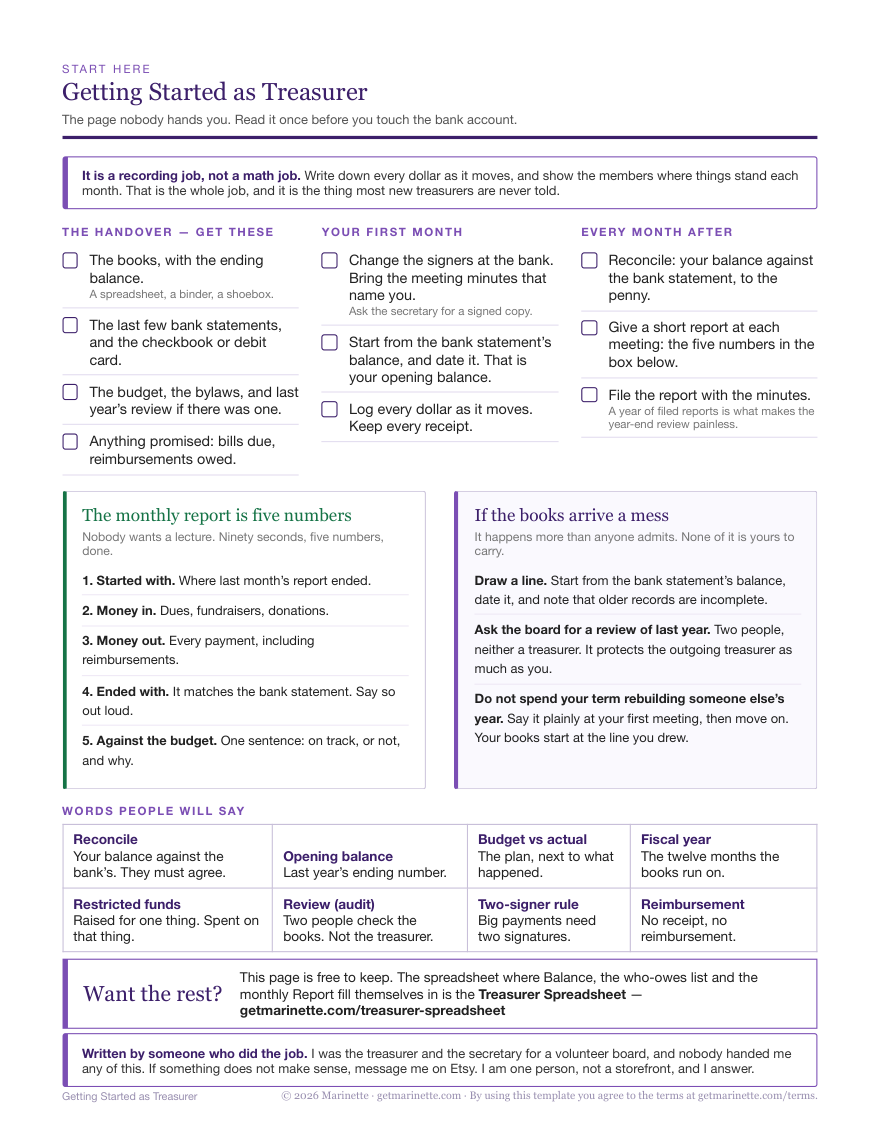
It’s a recording job, not a math job. You write down every dollar as it moves, and once a month you tell the members where things stand. That’s it. Nobody tells you that part, which is why the job feels so much bigger than it is when it lands on you.
The handover, your first month, and the rhythm
The handover — get these
- The books, whatever shape they’re in, and the ending balance. Could be a spreadsheet, could be a shoebox. You just need the number.
- The last few bank statements, plus the checkbook or the debit card.
- The budget and the bylaws. Last year’s review too, if anybody did one.
- A note of anything already promised. Bills that are due, reimbursements somebody is still waiting on, a deposit that hasn’t landed yet.
Your first month
- Change the signers at the bank. They’ll want the meeting minutes that name you, so ask the secretary for a signed copy before you go.
- Start from the bank statement’s balance and put the date on it. That’s your opening balance.
- Log every dollar as it moves, one line each. Keep the receipt for anything you pay out.
Every month after
- Reconcile: your balance against the bank statement. They should agree down to the penny.
- Give a short report at each meeting: the five numbers below.
- File the report with the minutes. A year of those filed away is what makes the year-end review painless instead of a scramble.
The monthly report is five numbers
Nobody wants a lecture and nobody’s grading you. Ninety seconds at the meeting, five numbers, done:
- 1. Started with. Where last month’s report ended.
- 2. Money in. Dues and fundraisers, plus anything donated.
- 3. Money out. Every payment, including reimbursements.
- 4. Ended with. It matches the bank statement. Say that out loud, because it’s the part the members are actually listening for.
- 5. Against the budget. One sentence. On track or not, and why.
There’s a whole page on the report itself, with a layout you can copy and the ninety-second version you read out loud: the monthly treasurer report, with a template.
If the books arrive a mess
It happens more than anyone admits, and none of it is yours to carry:
- Draw a line. Start your books from the bank statement’s balance, date it, and write down that the older records are incomplete.
- Ask the board for a review of last year. Two people, neither of them a treasurer. It protects whoever had the job before you as much as it protects you.
- Don’t spend your term rebuilding someone else’s year. Your books start at the line you drew.
- Say it plainly at your first meeting, then move on. Something like: “The records before March are incomplete. Here’s where we start.” You don’t owe anyone more than that.
What it was actually like
I was a PTA treasurer before I built any of this. Here’s what the job was like from the inside.
What did you get from the treasurer before you? A binder, check stock, some green tea, envelopes, and a USB key for Quicken. The binder was physical, with tons of printed-out pages in it, but it was pretty organized. We had to use AirDrop for the USB key, since computers don’t have USB anymore.
How hard was it to get on the bank account? It was somewhat difficult. Someone at the school needed to grant access, and the school is always very busy with much more important things.
What did you get wrong at first? I didn’t know I had to sign the packets. I didn’t understand how budget approval worked, and I didn’t understand what parts of the budget people were vested in vs. not.
What did nobody tell you? People do care about the budget and the money, and they will ask questions that surprise you. You need to be on top of things as the treasurer. The money matters. The budget matters.
What do people react to at the meeting? They ask about the things they care about for sure.
What happens when the numbers don’t match? Mistakes happen, and you have to take a deep breath, because it’s going to take more time than you planned for. Then you figure out what formula or math was wrong, or put in the wrong place.
What do people ask you about reimbursements? They ask about timing. Where is their check, what can they reimburse?
Do you get audited? We audit at the end of the year with the business office, and every quarter too.
What took the most time? Cutting checks. That’s why Marinette started.
What would you tell a friend who just got voted in? Automate as much as possible, and just review and check everything as you go. You can’t automate 100%, but probably 80%.
That 80% is what the Treasurer Spreadsheet is: you log money as it moves, and the Balance, the who-owes list and the monthly Report fill themselves in. Still running meetings on paper? The Treasurer Binder is the print side, with report forms, a money log, cash counts and the year-end checklist.
Words people will say
Reconcile
Your balance against the bank’s. They have to agree.
Opening balance
Last year’s ending number.
Budget vs actual
The plan, next to what happened.
Fiscal year
The twelve months the books run on.
Restricted funds
Raised for one thing. Spent on that thing.
Review (audit)
Two people check the books. Not the treasurer.
Two-signer rule
Big payments need two signatures.
Reimbursement
No receipt, no reimbursement.