What a treasurer report includes
Nobody wants a lecture and nobody's grading you. A monthly treasurer report answers one question: where did the money go this month? Five numbers cover it.
- 1. Beginning balance. Where last month's report ended. If this is your first report, it's the bank balance on the day you took over.
- 2. Money in. Dues, fundraisers, event income, donations. Group it by category so the board can see what actually raised money.
- 3. Money out. Every payment, including reimbursements. Same idea: grouped by category, not listed check by check.
- 4. Ending balance. It matches the bank statement. Say that sentence out loud at the meeting, because it's the one the members are actually listening for.
- 5. Against the budget. One sentence. On track or not, and why.
These are the same five numbers the free one-page guide for new treasurers teaches. This page is the report itself: what it looks like on paper and how to produce one every month without dreading it.
A treasurer report template you can copy
Here's the whole layout. Copy it into a fresh Google Sheet or a doc, swap in your organization's name, and type the numbers each month.
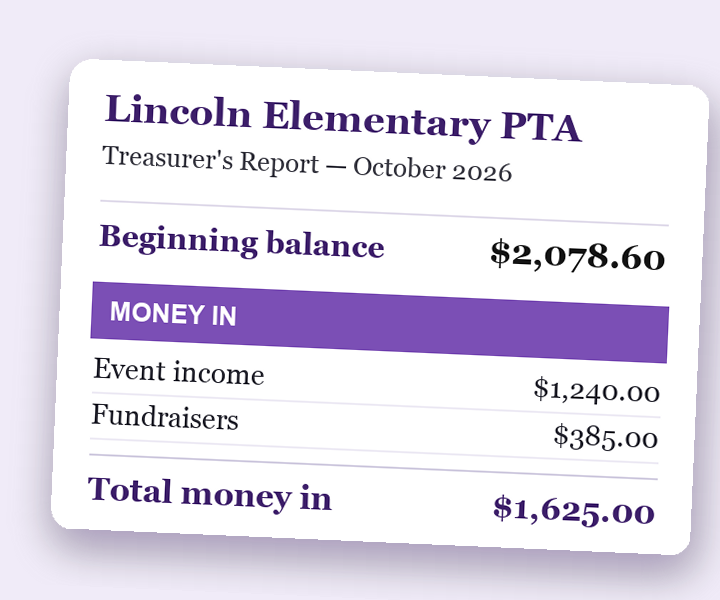
Lincoln Elementary PTA
Treasurer's Report · October 2026
| Beginning balance (Oct 1) | $2,078.60 |
| Money in: dues $310, fall festival $1,240, bake sale $385 | $1,935.00 |
| Money out: festival costs $612, supplies $184, reimbursements $95 | $891.00 |
| Ending balance (Oct 31), matches the bank statement | $3,122.60 |
Against the budget: fall festival came in $140 under its expense budget. On track for the year.
Six lines. That's the entire report.
If you'd rather not build and total it by hand every month, the Treasurer Spreadsheet produces this exact handout from your money log: you record money in and out as it happens, pick the month from a dropdown, and the report fills itself in, ready to print for the meeting.
Reading it at the meeting: the ninety-second script
"We started October with $2,078.60. We took in $1,935, most of it from the fall festival. We spent $891, including the festival costs and two reimbursements. We ended the month with $3,122.60, and that matches the bank statement. Festival came in about $140 under budget, so we're on track for the year. Happy to take questions."
That's the whole job. The sentence that matters most is "and that matches the bank statement": it means you reconciled, and reconciling is what protects you, the treasurer before you, and the one after. If something doesn't match, say what and why: a check that hasn't cleared is a normal sentence, not a confession.